
Three Cards on the Table
Getting your team to engage their head and their heart
Dr. Tracey C. Jones|T3 Solutions
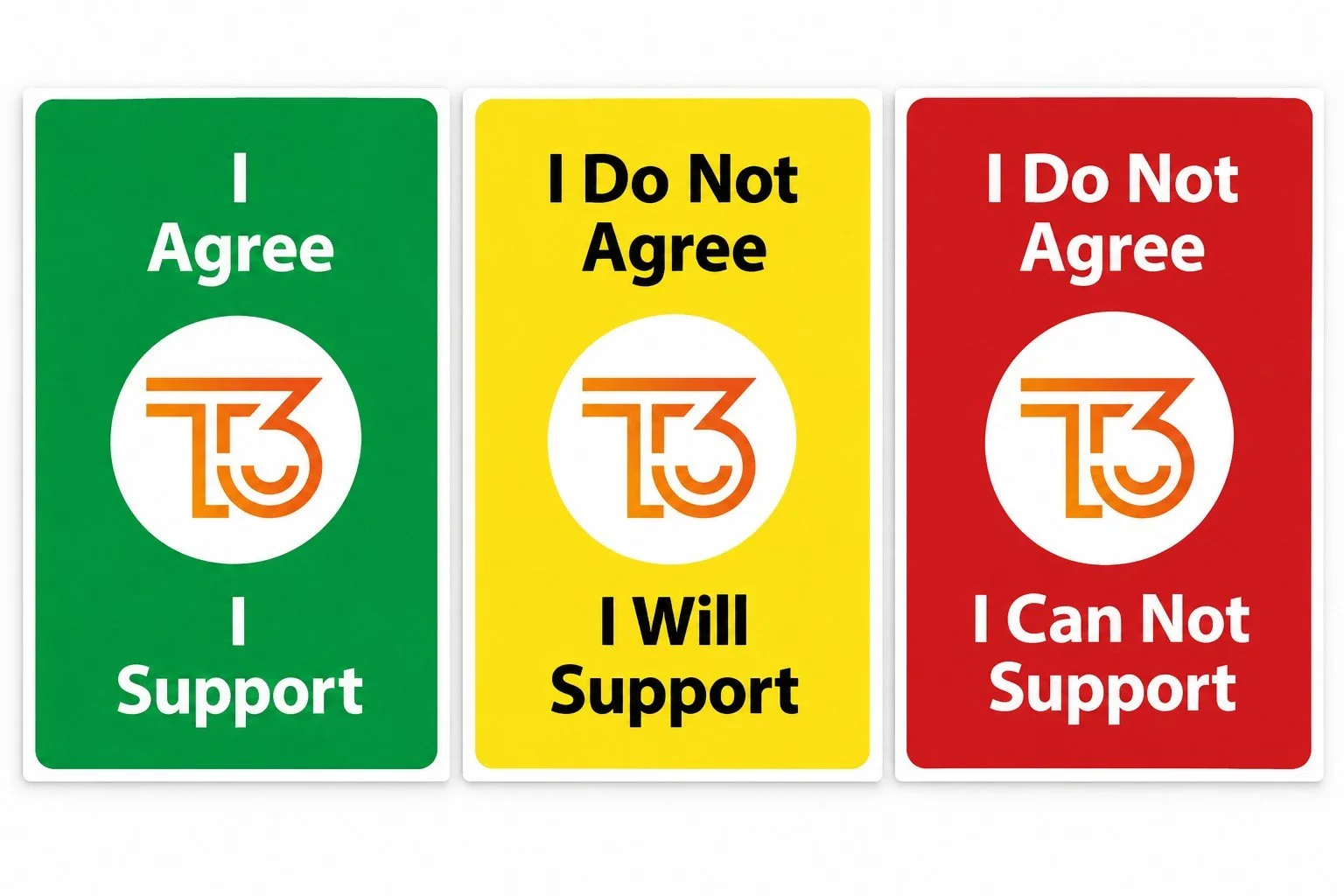
Mike Patterson, Chief Branding Officer at Horizon Federal Credit Union, gave me a set of the laminated cards his leadership team uses in their meetings. There are three of them, color-coded like a stoplight. The green card reads I Agree, I Support. The yellow card reads I Do Not Agree, I Will Support. The red card reads I Do Not Agree, I Can Not Support. Every person at the table has a set in front of them, and when a decision comes up, they hold one up.
That is the entire mechanism. No facilitator, no framework, no module to complete. Three pieces of cardstock that require a human being to put a color on the table where everyone can see it. The design does something most culture work never manages, which is to make a position cost something to hold. The idea came to Horizon from another leadership coach, Dr. Michael Greenwood, and Mike was glad to pass it along. I took Mike’s card and placed my own logo in the center where his sits, which is the version you see here.
What the cards take away is the option most of us reach for without ever admitting we reached for it: saying nothing in the room and everything in the parking lot. You cannot hold up green and then spend the next quarter quietly distancing yourself from the decision. You cannot hold up red and stay vague about why. The cards force discussion, they force commitment, and where there is neither, they force visibility. Nobody gets to hide in the shadows.
Based on the many clients I work with, and I include myself in this, constructive dissent is one of the hardest things we ask of leaders and followers alike. It requires two things at once that feel like opposites. Tell the truth, then get behind the call. Mike puts it better than I do: know how to row the boat before you rock the boat. Earn your standing first, then spend it. He also says that consensus is not a unanimous decision, which is a sentence worth taping to the wall of every conference room in America, because confusing those two things is what keeps a room circling a decision that was made an hour ago.
The green card
Green is a commitment, not a nod. When you lay it down you are saying you have thought it through, you are behind the decision, and your name goes on it next to the leader’s. Most decisions in a healthy organization should end in a table full of green, because people who work together and trust each other genuinely do agree most of the time. That is not weakness, that is what alignment looks like when it is real. The reason you still hold up the card is that agreement and silence look exactly alike from across a conference table, and only one of them is something you can be held to.
Look closely at what the green card asks of you and you will find the two dimensions Robert Kelley identified as the whole of effective followership. I Agree is independent critical thinking, the head, which means you ran the decision through your own judgment before you put your name anywhere near it. I Support is active engagement, the heart, which means your effort follows your conviction. Head and heart at the same time is what Kelley called the exemplary follower and what I call a tremendous one. The card will not let you bring one without the other, and that is precisely why it belongs on the table even when everybody in the room already agrees.
The green card that counts is the one held up after you have said your piece. In my latest book, Natural Born Follower, I make the point that a follower who salutes without ever having told the truth has not been loyal. They have been absent. Green held up out of conviction puts your full weight behind the call. Green held up because the meeting is running long and you would rather not be the one slowing it down puts nothing behind anything, and the leader who never hears bad news from their own people will eventually hear it from somebody else, at a much worse moment and usually at a much higher price.
The yellow card
Yellow is where the actual labor happens, and it is the only card of the three that separates agreement from support. I do not agree, I will support. That distinction is the whole of what I call aligning up. Alignment is not agreement; it is shared purpose in motion. You can believe a decision is second best and still execute it with everything you have, and the ability to do exactly that is one of the rarest and most valuable things you can offer an employer. Most people can carry out what they already agree with. Almost anybody can. The differentiator is the person who can carry out a decision they argued against, without dragging their feet and without letting the team see them do it.
The sequence matters enormously, because people love to quote the second half and skip the first. Speak your mind respectfully, then salute and soldier on. Both halves, in that order. If you sign the back of a paycheck rather than the front, that is your job description. The owner absorbs the risk, so the owner makes the call. Rank has its privileges, which is a thing people say with some resentment, but rank also has its responsibilities, and that is what makes the arrangement fair. The person who gets to decide is the person who has to answer for it.
The yellow card is also the one that tests the leader rather than the follower. Anybody can preach candor. What a team learns is what happens to the first person who holds up yellow. If that person gets heard and then gets honored, the cards will work. If that person gets remembered for it the next time a promotion comes around, everyone in the room will go back to holding up green and meaning red, and no laminated cardstock in the world will fix it.
The red card
Red is the one people are afraid of, and held up honestly it is the most honorable of the three. I do not agree, I can not support. That is not a vote against the organization, it is a person saying out loud that they have reached the edge of what they can carry, and it comes with an obligation attached. If you truly cannot support the decision, then you cannot stay and work against it. You say it on the record, and then you go. I have held up that card in my own career, and looking back I would hold it up again, because there are decisions where you simply know it is time for you to go.
In my book I call this cleave or leave. If you cannot let it go and you will not talk it out, then you need to walk it out. Either you cleave, meaning you stay, you reset your heart, and you go back to work like a professional, or you leave cleanly and with your head up. What you do not get to do is stay in the building and withhold. That third option, where you keep drawing the paycheck while quietly working at half power and letting everyone feel your displeasure, is not integrity. It is sabotage with better manners, and it does more damage over a year than an honest resignation does in a week.
Red is not a card for a bad quarter. What sits on these tables are lawful decisions made by people with the authority to make them, so red says the direction is one you cannot put your effort behind, not that anything untoward is going on. If you are reaching for red because you are annoyed, because somebody got promoted ahead of you, because the reorganization went the other way, take a hard look before you pack. Grass gets green because somebody waters it, and while you are eyeing somebody else’s lawn, there is a fair chance somebody is eyeing yours.
Can you see how these would be effective in your meetings?
Three cards, a stoplight, and a room where everyone states a position and then stands in it. You could have a set on the table at your next leadership meeting.
The first time through will be awkward, and most of the room will hold up green while they work out whether you mean it. The first yellow is the one that matters, because that is when your people find out whether dissent is a value on the wall or a practice you run. Honor that one and the next comes faster.
The type of follower you are today is determining the type of leader you will be tomorrow, and the same is true of the rooms we build. A culture is not what we say we believe about candor. It is which card people have the courage to put on the table and stand behind.
(Stay tuned for the upcoming release of my new book on followership)
Dr. Tracey C. Jones
President & CEO, T3 Solutions